Types of Vanuatu Passport
Not every Vanuatu passport is the same document. Which type an investor receives and which types exist alongside it.
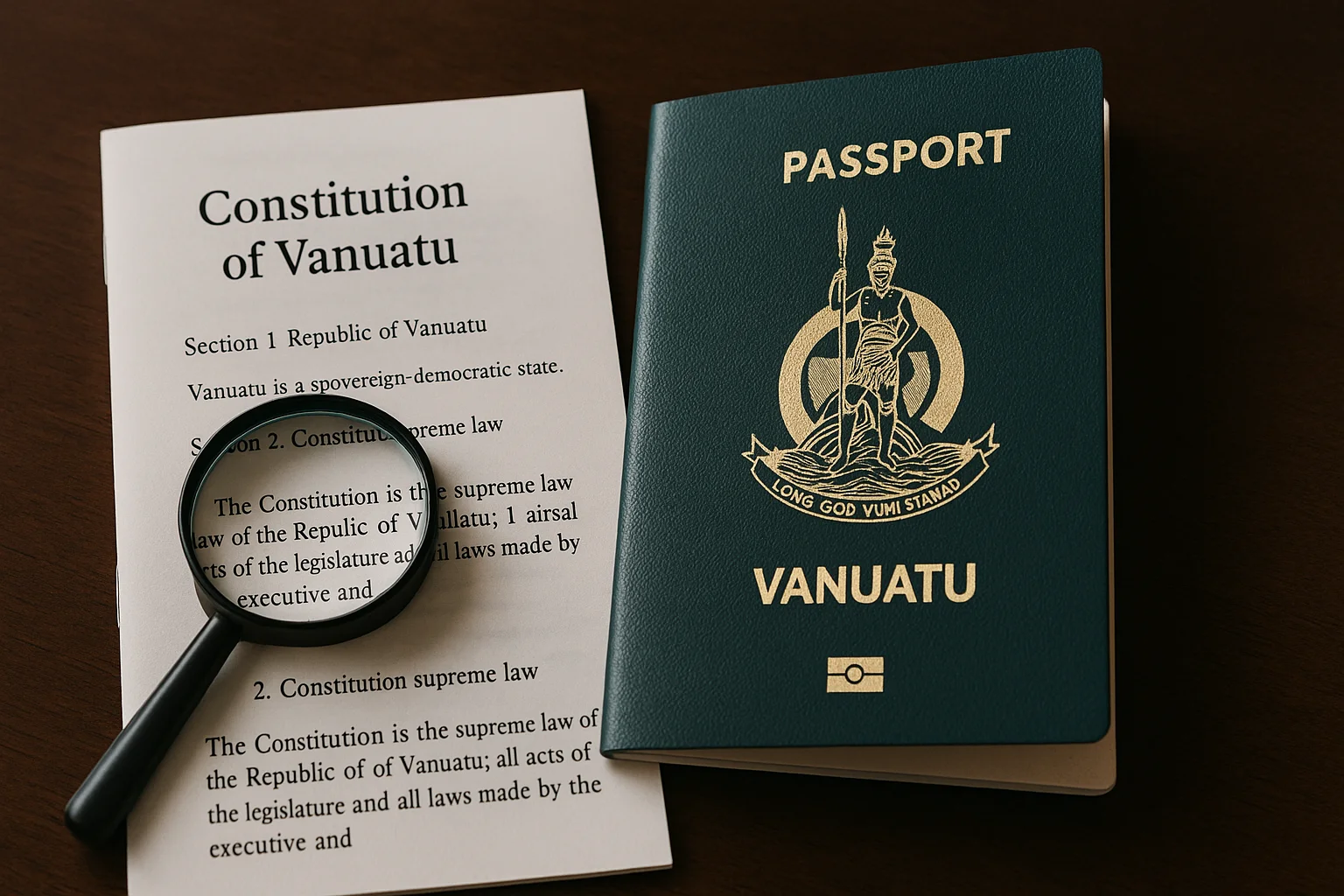
Vanuatu issues four main types of travel documents. You have the Ordinary Passport, the Official Passport, the Diplomatic Passport, and a temporary Certificate of Identity. If you get citizenship through an investment program like the Development Support Program (DSP), you receive an Ordinary Passport. It is legally and visually identical to the one a citizen by birth holds.
Here’s a critical distinction: the "type" of passport is separate from the "method" of getting citizenship. Whether you're a citizen by birth, descent, naturalization, or through the [Vanuatu Citizenship by Investment] program, the document you hold is the same Ordinary Passport. That said, the international standing of this passport has changed dramatically. The European Union and the United Kingdom imposed visa requirements between 2023 and 2025—a shift that impacts every single person holding a Vanuatu ordinary passport, no exceptions.
What Are the Official Categories of Vanuatu Passports?
Laws like the Passports Act No. 20 of 2009 and the Citizenship Act [Cap. 112] establish the legal framework for Vanuatu's travel documents. These acts create a clear passport hierarchy based on who you are and why you're traveling. And there's one non-negotiable rule, strictly enforced by the Vanuatu Passport Office and Immigration Department: you must be a Vanuatu citizen to get any type of passport. No citizenship, no passport. Simple as that.
The different passport types are not interchangeable. Each serves a specific role, carries different privileges, and is issued under its own set of criteria. Understanding these categories is the first step to knowing what kind of travel document you might be eligible for.
The Ordinary Passport
This is the standard travel document. The vast majority of Vanuatu citizens get an Ordinary Passport for tourism, personal travel, and business. It's the same document issued to citizens by birth, descent, standard naturalization, or those who have successfully completed a citizenship by investment program.
To an outsider, an Ordinary Passport gained through investment looks exactly like one held by a person born in Vanuatu. It's a biometric, machine-readable document that meets International Civil Aviation Organization (ICAO) standards, with a green cover and the national coat of arms. For adults, it's typically valid for 10 years. There is simply no marking to distinguish how citizenship was obtained.
The Official Passport
An Official Passport is different. It’s a specific travel document reserved for government officials, public servants, and others representing the Republic of Vanuatu on state business. Getting one isn't automatic. It requires an official letter from the relevant government ministry explaining why the travel is necessary.
Eligibility is strictly defined under Schedule 2 of the Passports Act. Crucially, this passport doesn't grant diplomatic immunity and is meant only for work-related travel. You cannot use it for a personal vacation. Once the official duties are complete, the passport is typically surrendered.
The Diplomatic Passport
At the top of the hierarchy is the Diplomatic Passport. It’s reserved for high-ranking state officials and diplomats representing Vanuatu abroad. Think ambassadors, government ministers, heads of diplomatic missions, and their eligible family members, as detailed in Schedule 1 of the Passports Act.
Holders might be entitled to certain privileges and immunities under international law, like the Vienna Convention on Diplomatic Relations (1961). But any such privilege is always at the discretion of the host country. The Ministry of Foreign Affairs issues these passports under strict protocols, and they are only for use during official diplomatic functions.
The Certificate of Identity
The Certificate of Identity isn't a full passport. It's an emergency, temporary travel document. Its main job is to help a Vanuatu citizen get back home if their passport is lost, stolen, or expired while they are abroad. It's usually a one-way document issued by a Vanuatu diplomatic mission.
Vanuatu also uses this document to meet its obligations under international treaties like the 1951 Refugee Convention. A Certificate of Identity might be issued to refugees or stateless persons lawfully residing in Vanuatu, giving them a way to travel. Its validity is short, and far fewer countries accept it compared to a standard passport.
How Do You Apply for a Vanuatu Passport?
The Vanuatu Passport Office, a part of the Immigration Department, handles all applications. The procedure is built to rigorously verify two things: your identity and, most importantly, your status as a Vanuatu citizen. This core requirement is absolute, whether your citizenship came from being born on the islands or from a major financial investment.
The standard process involves filling out the application, submitting required documents, paying government fees, and providing biometrics like a photo and fingerprints. For those who used a Citizenship by Investment (CBI) program, the passport application is the last step. It’s usually handled for them by a government-authorized "designated agent" right after the Citizenship Commission formally grants their citizenship.
What are the Vanuatu passport requirements?
To apply for an Ordinary Passport, you must provide a folder of documents proving your identity and citizenship. While the small details can shift, the core requirements usually include:
- The completed and signed passport application form. Any missing signature is an immediate rejection, so double-check before submitting.
- Your original Birth Certificate.
- Proof of citizenship. For investors, this is the official Citizenship Certificate issued by the Vanuatu Citizenship Commission.
- A Vanuatu National ID card (Vanuatu I.D Card).
- Recent, compliant passport-sized photographs.
For applicants under 18, a "Consent to issue a passport to a person under 18 years of age" form is mandatory. It must be signed by at least one parent or a legal guardian named on the birth certificate. All government application fees must be paid in full when you submit. The Immigration Department says ordinary processing can take up to 21 days—which means you should plan for at least a month from submission to having the passport, so don't book non-refundable travel based on a faster timeline.
What is the Vanuatu passport price?
It's critical to separate the cost of the physical passport book from the cost of the citizenship that lets you apply for it. The passport application fee is a small administrative charge, currently VT 5,000 for normal processing (around USD 40-50).
But when people talk about the "Vanuatu passport price," they almost always mean the Citizenship by Investment program. The main path, the Development Support Program (DSP), requires a minimum non-refundable contribution to the government. As of 2026, this is USD 130,000 for a single applicant, not including due diligence and agent fees. That contribution is the real "price" of the citizenship that makes the passport possible.
For anyone considering this route, it's essential to [Explore the full cost breakdown and application process for the Vanuatu CBI program] to get a clear picture of all the expenses involved.
How Powerful is a Vanuatu Passport in 2026?
A passport's "power" is really a measure of global mobility. In 2026, the Vanuatu passport's strength is a complex story. While it still offers access to a good number of countries, its capabilities were fundamentally changed by major policy shifts in Europe. The single biggest blow was the European Union's full suspension of its visa-waiver agreement, which took complete effect on February 4, 2025.
As of early 2026, various rankings place the Vanuatu passport in the global mid-tier. Its Mobility Score might hover around 93, counting the total destinations you can access without a pre-arranged visa. This number, however, includes visa-on-arrival and eTA access and doesn't consider the economic importance of those countries. The core reason for its diminished power was the EU and UK's public concerns over the due diligence standards of Vanuatu's CBI programs, which prompted them to revoke visa-free access for everyone.
What is the Vanuatu passport visa-free countries list for 2026?
As of 2026, a Vanuatu passport holder can get into over 90 countries and territories either visa-free or with a visa-on-arrival. But remember this list is always in flux, and entry rules can change fast.
Key visa-free destinations include Asian hubs like Hong Kong and Singapore, plus countries like Russia and Israel, and most nations in the Caribbean and Africa. Still, some "visa-free" travel isn't completely friction-free. It may require pre-registration, like the Singapore Arrival Card or Seychelles tourist registration—these are simple online forms, but they are mandatory and must be done before you travel.
Always verify the latest entry rules with your airline or the destination country's embassy before you book anything. For a more detailed, frequently updated list, consult a dedicated [Vanuatu Passport Visa-Free Countries] resource.
Why is there no Vanuatu passport visa-free Europe access?
Access to Europe is the most significant change. The European Union fully suspended its visa-waiver agreement for all Vanuatu citizens, no matter how they got their passport. This was phased in and became final on February 4, 2025. The EU's legal basis was a regulation citing worries that Vanuatu's investor citizenship schemes posed a security risk to the Union.
Separately, and for similar reasons, the United Kingdom imposed its own visa requirement on all Vanuatu nationals back in July 2023. The result is that any travel to the 27 EU Schengen Area countries, plus the UK and Ireland, now requires getting a visa in advance.
Does the passport provide visa-free access to Australia?
No. It's a surprisingly common question, but the answer is a firm no. Vanuatu citizens have never had visa-free access to Australia for tourism or business. Don't let the recent EU and UK changes confuse the issue; Australia's policy is entirely separate and has been in place for decades. If you plan to travel there, you must apply for a visa through standard Australian immigration channels, a process that requires planning and has its own set of requirements.
Does Vanuatu Recognize Dual Citizenship?
Yes, absolutely. Since a pivotal amendment to the Citizenship Act [Cap. 112] in 2013, Vanuatu's laws fully embrace dual citizenship. Before this change, a Ni-Vanuatu citizen risked losing their status if they acquired another nationality. The old rule simply wasn't compatible with a modern, globalized world.
That 2013 legal shift was the bedrock that allowed the country's citizenship by investment programs to flourish. It provides a crucial assurance to investors: you will not be asked to renounce your original citizenship. You can legally hold a Vanuatu passport right alongside your current one, which is a non-negotiable feature for most people seeking the security of a second passport without severing ties to their home country.
What Are the Key Legal and International Considerations?
Understanding a Vanuatu passport requires splitting your thinking in two: domestic law versus international relations. Under its own sovereign laws, affirmed in cases like Suta v Republic of Vanuatu, Vanuatu has the absolute right to grant citizenship. Your citizenship certificate is a 100% legally valid document inside Vanuatu.
Here's the thing: international law works differently. Every other nation retains its own sovereign right to control its borders, a principle baked into agreements like the Chicago Convention on International Aviation (1944). Each country decides for itself whose documents it will accept for entry and under what conditions.
No global treaty forces the United States, the UK, or any EU state to grant visa-free entry to a Vanuatu passport holder. These travel privileges are built on bilateral agreements and can be withdrawn unilaterally. The EU and UK's decision to revoke visa-free access is this principle in action. So while your Vanuatu citizenship itself is legally secure, the power of the travel document it provides is always subject to the foreign policy of other nations.
This article is published by an independent law firm for informational purposes only and does not represent or claim affiliation with any government body, international organization, or official authority.
Questions
Frequently Asked Questions
Its strength has become highly situational. The passport was once considered moderately strong because of its visa-free access to the EU and UK. With those agreements suspended, its power for anyone prioritizing European travel is significantly reduced. Still, it provides visa-free access to over 90 countries, including Hong Kong and Singapore. The real question is whether its "strength" in 2026 matches your specific travel and business needs.
That's a common global question, but the number of passport types actually varies by country. Vanuatu issues three main types: Ordinary, Official, and Diplomatic. It also uses a temporary travel document, the Certificate of Identity. The "fifth type" people ask about is the investor passport, but this isn't a distinct legal category. It's simply an Ordinary Passport issued to a new citizen who qualified through an investment program.
Yes. A crucial 2013 amendment to the Citizenship Act [Cap. 112] legalized dual and multiple nationalities. This means you do not have to renounce your original citizenship to become a citizen of Vanuatu, a make-or-break feature for most investment applicants.
Whether it's "worth it" depends completely on your goals. For some, it's a definite yes. If you need a fast-processing second passport for mobility in Asia, potential tax advantages, or a foothold in a different part of the world, it remains a powerful tool and the only active CIP in the Asia-Pacific. But if your main goal was visa-free travel to the EU or UK, its value proposition has fallen sharply.
As of 2026, the passport provides visa-free or visa-on-arrival access to over 90 destinations. This includes key hubs like Hong Kong, Singapore, Israel, and Russia, plus many countries across Africa, Oceania, and the Caribbean. Crucially, this list does not include the EU Schengen Area, the UK, the USA, Canada, or Australia. Always verify the current list from official sources before you book any travel, as these agreements can change with little notice. { "@context": "https://schema.org", "@graph": [ { "@type": "Article", "headline": "A Detailed Look at All Vanuatu Passport Types", "datePubli
Contact Us
Schedule Your Free Case Evaluation Today
Share the details of your situation with our team, and we'll provide a prompt, confidential response. We're here to listen, answer your questions, and help you understand your legal options.
Send Us a Message
Reach Us Directly
All consultations are strictly confidential and protected by legal professional privilege.